Are You Actually Capturing Every WOTC Tax Credit?

Kirk Conole • June 10, 2026

Many employers who hire blue-collar workers assume they're receiving every available Work Opportunity Tax Credit (WOTC). The reality is that many companies lose valuable tax credits simply because the process isn't being monitored correctly.


One of the easiest ways to verify compliance is through a monthly reporting system. A simple report should clearly show:

  • New hires screened on time
  • Missed forms
  • Late submissions
  • Overall compliance percentage


In the example below, the employer achieved:

  • 100% of new hires screened on time
  • 0 missed forms
  • 0 late forms


That level of compliance helps ensure tax credits are protected and available when it's time to file.


The problem is that many organizations never receive this type of visibility. Without regular reporting, missed screenings and late paperwork can quietly eliminate tax credits that should have been captured.


The financial impact can be significant. Even a relatively small number of qualified hires may generate thousands of dollars in tax savings. In many cases, companies discover additional opportunities through an independent audit of their tax credit and operational processes.


A thorough forensic review often uncovers overlooked savings, compliance gaps, and process inefficiencies. For many organizations, the combined effect can translate into meaningful cash flow improvements without changing vendors, disrupting operations, or taking on additional risk.


The question isn't whether WOTC credits exist for your workforce. The question is whether you're capturing every dollar you're entitled to.


When was the last time an outside expert reviewed your process?


Being busy is understandable. Leaving money on the table isn't.
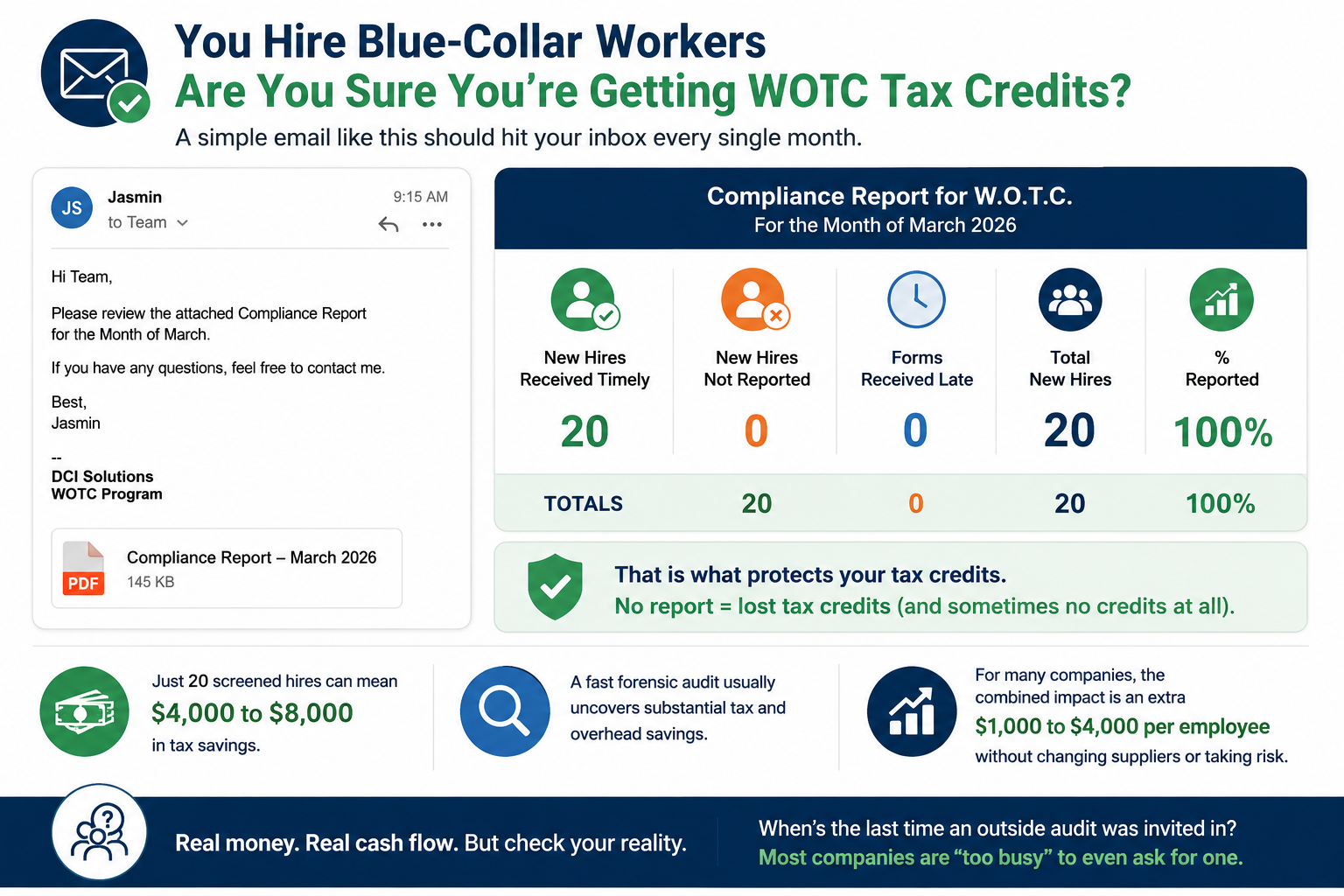
Blue flyer about WOTC tax credits for blue-collar workers, with stats and icons showing eligibility and savings.

Let's Talk

At DCI Solutions, we help companies take a more strategic approach to savings.


If you’d like to learn more about how DCI can help your company, we’re happy to have a conversation.


Please feel free to contact us here: info@dcisolutions.net | 760-809-8734  or set up a meeting here .
By Kirk Conole June 4, 2026
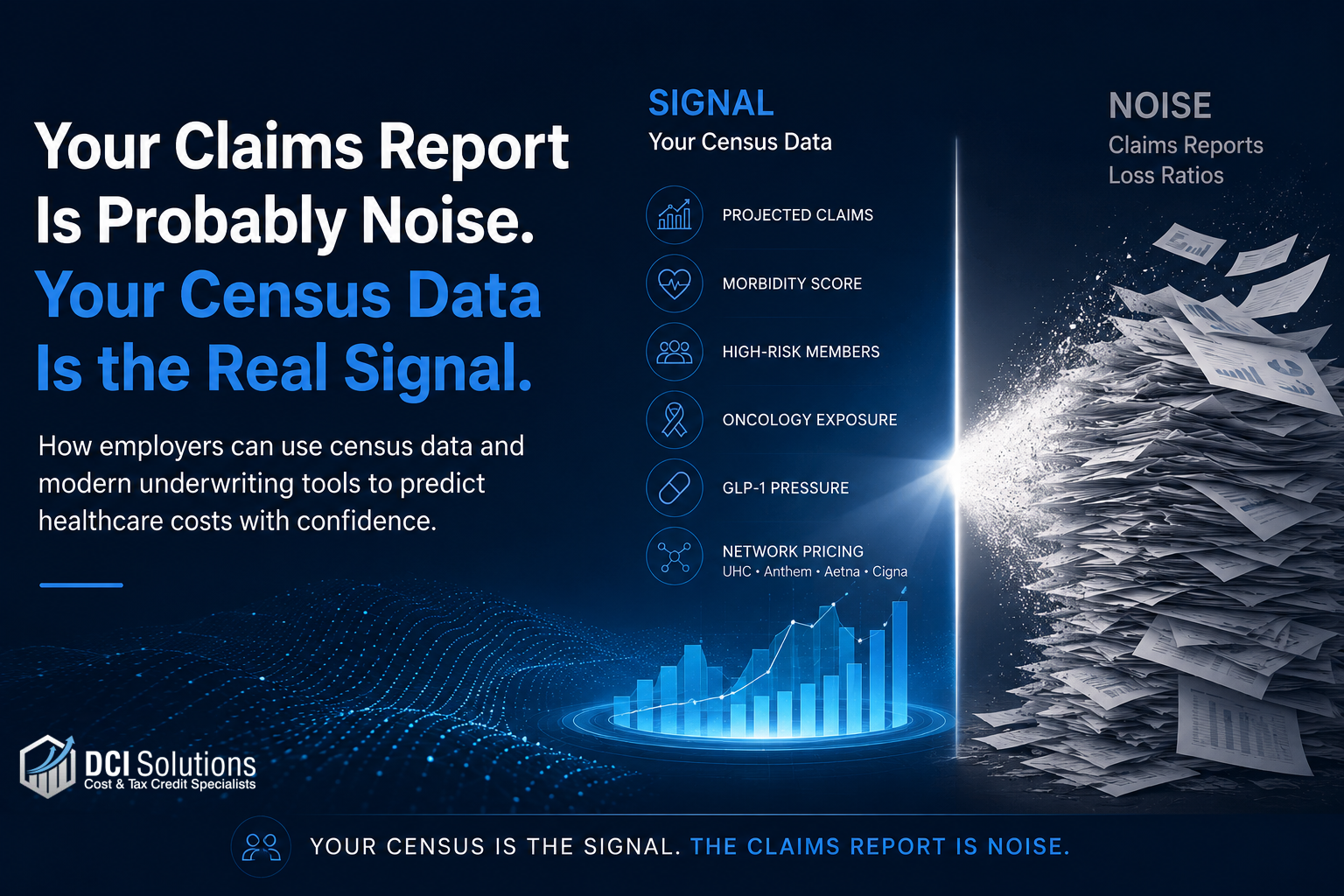
For decades, employers have been conditioned to believe that health insurance claims reports are the key to understanding healthcare costs. They're not. In fact, by the time most employers receive a claims report, the information is already historical. It tells you what happened, not what's likely to happen next.  That's a problem when healthcare spending continues to rise and employers are being asked to make critical decisions about funding strategies, stop-loss coverage, network selection, and employee benefits.
Man walking on a road at sunset with bold text about hard work, discipline, and performance standards.
By Kirk Conole May 27, 2026
Learn how high performance standards reveal hidden savings in your business. Contact DCI Solutions for expert cost management today!
Elevator lobby with text about cutting maintenance overcharges by 70% and saving $185,000 per year.
By Kirk Conole May 18, 2026
Learn how a private college cut elevator maintenance costs by 70%, saving $185,000 annually. Contact DCI Solutions for effective strategies.
Infographic showing a restaurant’s 45% healthcare cost reduction, with before-and-after cost figures and a blue city backdrop
By Kirk Conole May 14, 2026
Learn how a restaurant group cut healthcare costs by 45% using self-funding & AI analytics. Contact us to explore similar savings!
By Kirk Conole May 8, 2026
Most companies accept annual freight increases as unavoidable. FedEx Freight’s LTL general rate increased 5.9% from 2023 to 2024, and then another 5.9% from 2024 to 2025. Over time, these annual General Rate Increases (GRIs) quietly compound into a major expense line that most businesses never fully challenge. But what if you could reverse the impact of those increases?
Hire students, unlock hidden tax credits; three smiling students in blue promo graphic.
By Kirk Conole May 7, 2026
Employers can unlock federal tax credits by hiring student employees. Contact DCI Solutions to maximize your savings today!
By Kirk Conole April 24, 2026
For many businesses, healthcare is one of the largest and fastest-growing expenses on the balance sheet. Yet the way most companies manage it hasn’t changed in decades. A recent case we worked on highlights just how costly that can be.
A professional team in business attire gathers around a laptop in an office, smiling as they collaborate on a project.
By Kirk Conole October 27, 2025
Employee engagement determines a company’s health and profitability. Across a wide number of companies, Gallup reports that the level of employee engagement follows a “1/6 : 2/6 : 3/6” ratio. 1 out of 6 employees (including management) resist the ownership’s goals and vision. 2 out of 6 support the ownership’s goals and vision. 3 out of 6 are “neutral.” They can be swayed by either the “resisters” or the “supporters.” Owners and executives should understand that they are competing every day with the “resisting “1 /6” to win over the neutral “3 / 6” and to sustain supportive engagement from the “2/6.” To improve the chances of winning this competition, leaders should recognize and avoid two common flaws: FLAW #1: CRITICAL LEADERSHIP “Critical Leadership” results in staff feeling less than fully appreciated if not rewarded for taking informed but unrequired risks that could be in the best interest of the company’s ownership. Example: The CFO and the controller of a privately held company understood how a specialized tax credit and cost review would recover substantial amounts of cash. “The problem,” he said behind closed doors, “is the owner of this company would criticize us for not being able to find this money all by ourselves without you. We can’t have that.” In this example, the company owners and all of the “stakeholders” lose valuable cash because an “Insufficiently Engaged Employee” didn’t want to accept what was misperceived as personal risk. FLAW #2: REMOTE LEADERSHIP The best leadership is close enough to offer clear guidance, incentives and accountability to ensure the organization’s health and profitability. When personal attention is too remote for too long a period of time, the important opportunities that should be first brought to the owner/CEO for an informed decision and then implemented by the staff are ignored or blocked. Instead, those opportunities are left for the staff to review and pursue or ignore according to their “personal perspective” and desire to avoid “personal risk.” This “Abdelegation” (combination of delegation mixed with abdication) is why too many great decisions and gains don’t get made in time, if ever. Example: For the last few years, an AP audit/recovery service recovered millions for a Fortune 1000 company. In response to a corporate directive to cut costs, the accounting department either had to let go of a well-liked staff member or discontinue the AP audit/recovery service, which was paying for itself many times over. The department discontinued the service. The company is now in worse financial condition than when the accounting department was asked to cut costs. Penny-wise and pound-foolish? Obviously, YES! But when given the opportunity to save jobs, many people will do so – even when it hurts the company and the common good. In both cases the decisions made by executives and staff were inline chiefly with the best interests of the company’s management personnel rather than the company or the company’s owner(s). The alternative is to replace the perspective of being overbearing and remote bosses to apply a leadership practice that causes employees to perceive them not as bosses, but as “Fully Engaged Employee-Centered Leaders.” To lead better, an owner/CEO should start with the assumption that the employer’s profitability is still secondary to other work-related priorities held by his VPs and department heads. Their priorities include: job security, career advancement, autonomy, peace, compensation (pay benefits, flex time), recognition (office relationships, peer respect, recognition from superiors), personal development, and the avoidance of more stress/work for which there is no extra reward. One simple improvement leaders can use to improve employee engagement and corporate profits simultaneously is DCI’s “3-A Communication.” The 3-A’s are: Align. Show how your decisions/goals align with employee well being and with the big picture. Affirm. Show respect and care for those touched by your decisions. Assign. Clarify roles, expectations and rewards for people carrying out your decisions. As an example, clients of DCI use this memo which incorporates “3-A Leadership” principles: Our executive team is committed to continually improving our employee well being with cost structure and financial health without reducing the quality of the services we give or the services we deliver to our consumers. To achieve these goals, we have engaged DCI Solutions to identify opportunities within our tax and overhead structure for additional discounts, credits, and refunds. Their mandate is to help us see worthwhile recoveries and cost savings without creating any risk for or unreasonable burdens on our staff. At some point DCI may request your time or input in order to expedite a savings for the good of our company. Your cooperation in this matter is necessary and appreciated. The resulting success reflects well on each department and person involved. The more effective DCI is in saving money for the company, the more profits we will have to grow our business and bonus our people. If you have any questions, concerns, or needs that cannot best be addressed by DCI Solutions directly, please feel free to contact us: info@dcisolutions.net | 760-809-8734
A healthcare professional uses a manual sphygmomanometer and stethoscope to measure a patient's blood pressure.
By Kirk Conole October 27, 2025
If you could see a ranking of business owners and executives who best control healthcare costs and then designate the “top 1%,” you would have to include Susan, the owner of a retail chain in the Midwest. Susan is a “one percenter” in controlling healthcare costs for three reasons: 1) She commits to thinking rationally about healthcare. 100% of rational, fact-driven business owners and executives tend not to view healthcare costs with the same rational approach they apply to other significant expenses. Unlike other expenses, health insurance directly affects employees who are seldom educated adequately on how win/win scenarios can benefit both employee and employer at the same time. Usually, the employee expects the employer to have the best answers but the employer is under-resourced and assumes that a commissioned salesperson, the health insurance broker, will be able to figure it out with input from the HR department. The HR department is motivated to have all employees happy and not complaining. HR is also motivated to show that costs are not escalating dramatically year over year. All brokers want to keep the client and most want to keep the current level of commission – a motivation that too often automatically separates the broker’s interests from the client’s. “Some owners see a broker the way tribal villagers see the village shaman,” Susan shared with me. “He’s the guy who interprets the dark secrets, and saves the employees who wholly trust him alone to deal with the things they don’t understand. This gives employees a sense of safety and security.” After gaining a full understanding of healthcare costs without the “help” of her previous retail broker, Susan had an interesting way of dealing with that broker. “I threw him off the porch,” she said. 2) She has owner/HR alignment. Both Susan and her HR department must: a) share an objective understanding of all healthcare cost drivers, and b) master the best alternatives for reducing costs. Their ability to be fully engaged and aligned, which is more than mere agreement, is the second factor that makes Susan a member of the one percent. We aren’t suggesting they must do all of this on their own. They can rely on the truly UNBIASED insight and ongoing support of DCI. 3) Her total cost puts her in the one percent. The total cost of healthcare is more than just the premium amounts. The true cost of healthcare is: TOTAL PREMIUMS FOR THE EMPLOYEE ONLY (EMPLOYER & EMPLOYEE SHARE) PLUS ALL ADDITIONAL PREMIUMS PAID BY EMPLOYEE OR EMPLOYER TO COVER DEPENDENTS PLUS ALL DEDUCTIBLES AND COPAYS PAID BY THE EMPLOYER AND THE EMPLOYEE. Add up those three component numbers then divide the sum by the total number of employees in your plan. What do you get? For companies in the bottom 50% of cost-efficiency, this number will be greater than $12,000 per employee per year (PEPY) . For companies in the top 50%, this number may be closer to $8,000 PEPY. One percenters like Susan are well under $5,000 PEPY. If you don’t already know your full cost on a PEPY basis, do the math yourself now or call DCI to perform the math with zero bias. It might be true that no one besides your retail broker could possibly reduce costs any lower and without sacrificing quality, but why risk it? Before your company commits to another year of unnecessarily high costs, contact DCI. Our solutions and strategies do not require you to switch brokers or networks and you don’t have to reduce coverage or increase employee deductibles. Our analyses give you the insight and power to be a one percenter! info@dcisolutions.net | 760-809-8734
A 15-minute candlestick chart of a financial asset showing a price decline, with moving average lines on a black screen.
By Kirk Conole July 24, 2025
When it comes to SEO, there isn't a magic formula to instantly send your site off to the #1 search result on Google. But there are some basic principles you should follow for a wonderful starting point. Here are the top 5 SEO practices to start with: #1 Write for people, not for search engines Always write original, interesting, high quality site content that's error free and relevant to your site. Search engines like Google can easily detect content that is duplicated from elsewhere online, that contains grammatical errors, or that is stuffed with keywords. #2 Add a blog to your site and use rich media To engage your site visitors and blog readers, create posts that include non-textual media like photos, videos, or original visualizations (infographics). Having that extra content (especially if it's captivating) will increase the time users spend on your site as well as the likelihood they will share your site with their own community. #3 Offer a positive user experience throughout your site Google will know if you're using your site to aggressively advertise your service, or if you're being too pushy. Always aim to offer site visitors a pleasant experience on your site. That means clear content, support when needed, and always an option to go back. #4 Create a network of internal links (but don't overdo it) Add links between different pages of your site and your blog, but try to follow a process that feels organic rather than heavy linking meant just for search engine crawlers. Link between pages that make sense, for example, on your services page, link a certain industry specific term, and link it to a blog post you wrote about it, that gives more information on that term. #5 Always check your site's Core Web Vitals Core Web Vitals are a standard site performance standard initially created by Google. The report shows site owners how their site pages perform 'for real,' how long it takes for site visitors to load site pages, and it offers ways to fix issues, if there are any.