The Hardest Thing I’ve Done, And What It Taught Me About Performance Standards

Kirk Conole • May 27, 2026

Recently, I ended a 66-hour fast by attempting the most rigorous physical challenge of my life: carrying 170 pounds for a full mile in 45 minutes while breathing only through my nose. Painful? Absolutely. Glorious? Without question.


Why would anyone willingly do something like that?


Because difficult challenges reveal truth.


They expose weakness, sharpen discipline, and force you to operate at a higher standard. And the same principle applies in business, especially in areas where millions of dollars are quietly lost through poor oversight, outdated strategies, and low expectations.


At DCI Solutions, we see this constantly when organizations evaluate brokers, vendors, and healthcare advisors. Most firms claim to deliver savings. Few can withstand rigorous scrutiny.


That’s why, when clients consider replacing their current broker or benefits advisor, we encourage them to ask deeper questions, questions that go far beyond surface-level promises and standard renewals.

High Standards Separate Advisors from Order-Takers

Too many healthcare and benefits relationships operate on autopilot.


Renewals happen.
Rates increase.
Employees absorb higher costs.
Executives receive limited visibility.
And nobody asks whether the strategy itself is fundamentally flawed.


Real performance requires rigorous evaluation.


We challenge brokers and advisors with questions like:

  • What observations can you make about our plan’s performance based on actual data?
  • What would you have recommended differently over the last several years?
  • How do you monitor fiduciary responsibilities and vendor accountability?
  • What compensation arrangements or conflicts of interest exist?
  • How do you evaluate pharmacy contracts, stop-loss exposure, specialty drugs, and claims oversight?
  • What payment-integrity systems are actively protecting the plan from waste?


Most importantly:

Can they prove measurable results?


Because in today’s healthcare environment, “shopping the market” once a year is not a strategy.

The Hidden Cost of Low Expectations

Many organizations unknowingly tolerate enormous inefficiencies simply because nobody has challenged the status quo.


Poor transparency clauses.
Hidden compensation structures.
Inefficient pharmacy arrangements.
Unmanaged large claims.
Weak reporting.
Limited executive oversight.


These issues quietly drain cash flow year after year.


The companies achieving meaningful savings aren’t necessarily working harder; they’re operating with higher standards, better data, and more disciplined oversight.


That’s true whether you’re carrying 170 pounds for a mile… or managing an eight-figure healthcare spend.

Discipline Creates Clarity

Physical challenges teach you something business often hides:


There’s no shortcut around discomfort.


Growth requires pressure.
Improvement requires accountability.
Results require rigor.


The rare broker, consultant, or advisor capable of meeting elite standards and winning a large client should feel proud of that achievement. They earned it.


The same is true for executives who refuse to accept rising costs as “just part of doing business.”

What Standards Are You Setting?

The question isn’t whether your organization is spending money.


The question is whether anyone is rigorously testing the systems behind that spending.


At DCI Solutions, we help organizations uncover hidden opportunities within healthcare, overhead, taxes, freight, telecom, and operational expenses, often without changing vendors or requiring capital investment.


Because the biggest savings opportunities are usually hidden behind assumptions nobody thought to challenge.


And just like any difficult challenge, the results can be painful at first…


…but ultimately glorious.
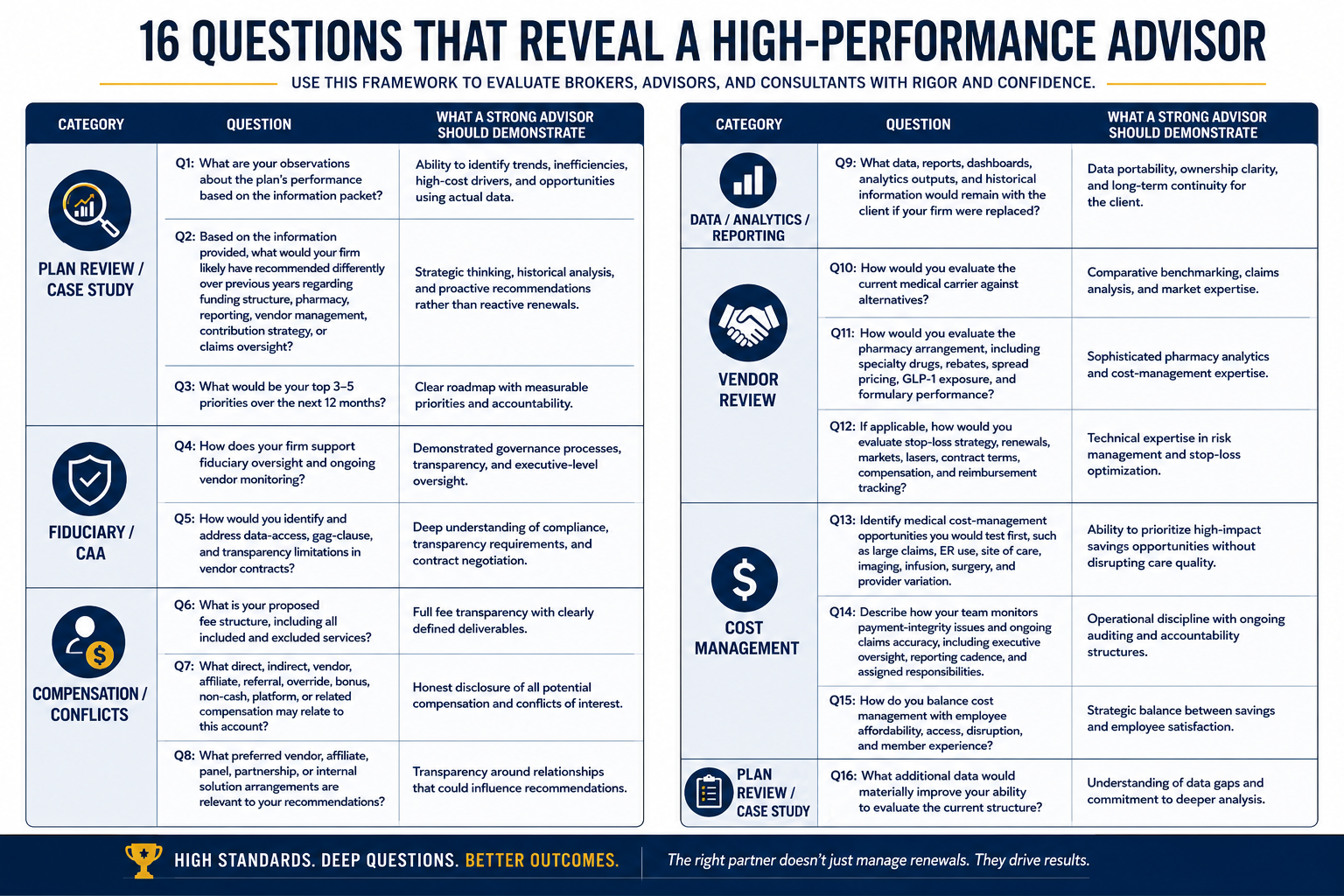
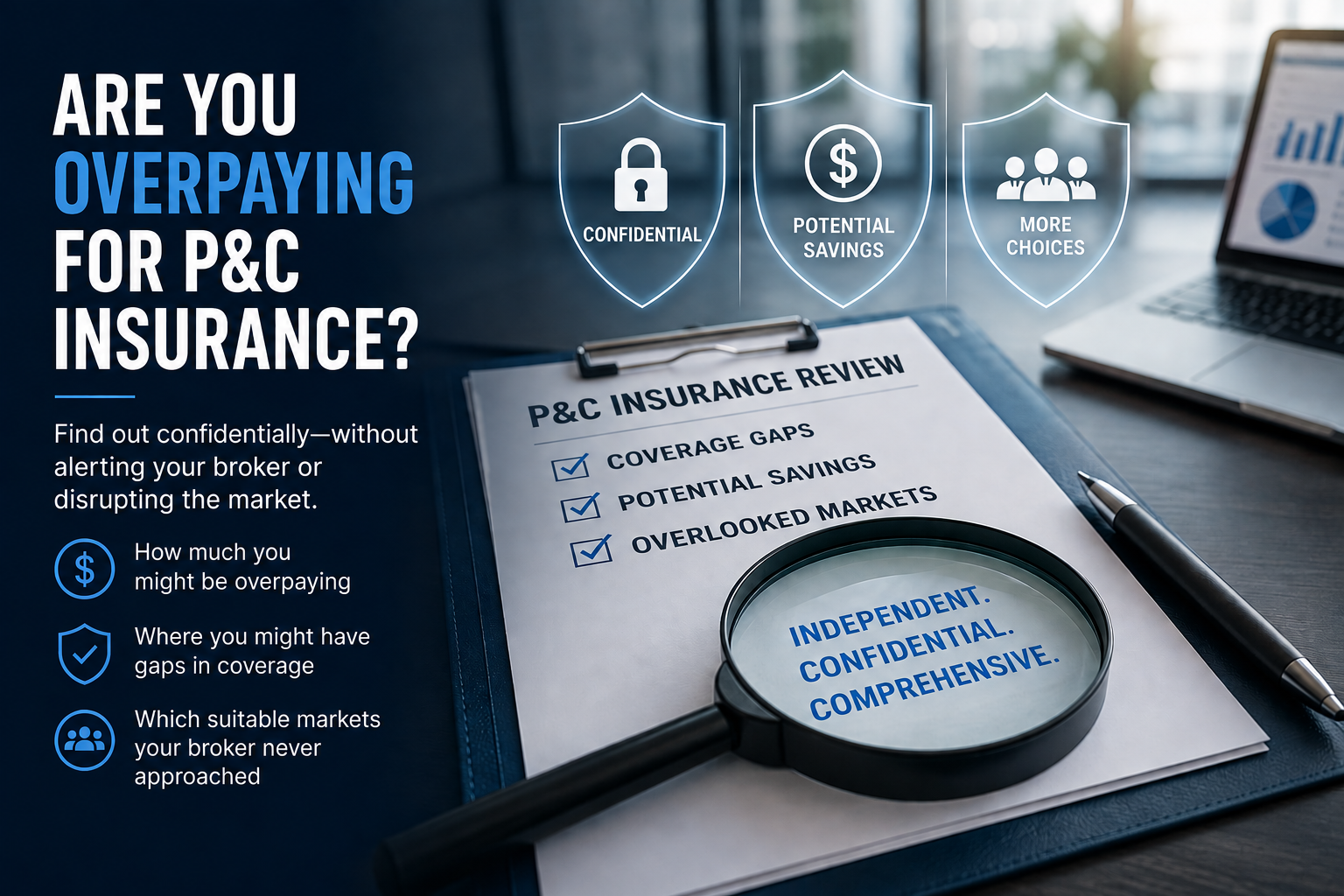
Infographic titled “16 Questions That Reveal a High-Performance Advisor,” with blue icons and two-column text blocks.

Let's Talk

At DCI Solutions, we help companies take a more strategic approach to savings.


If you’d like to learn more about how DCI can help your company, we’re happy to have a conversation.


Please feel free to contact us here: info@dcisolutions.net | 760-809-8734  or set up a meeting here .

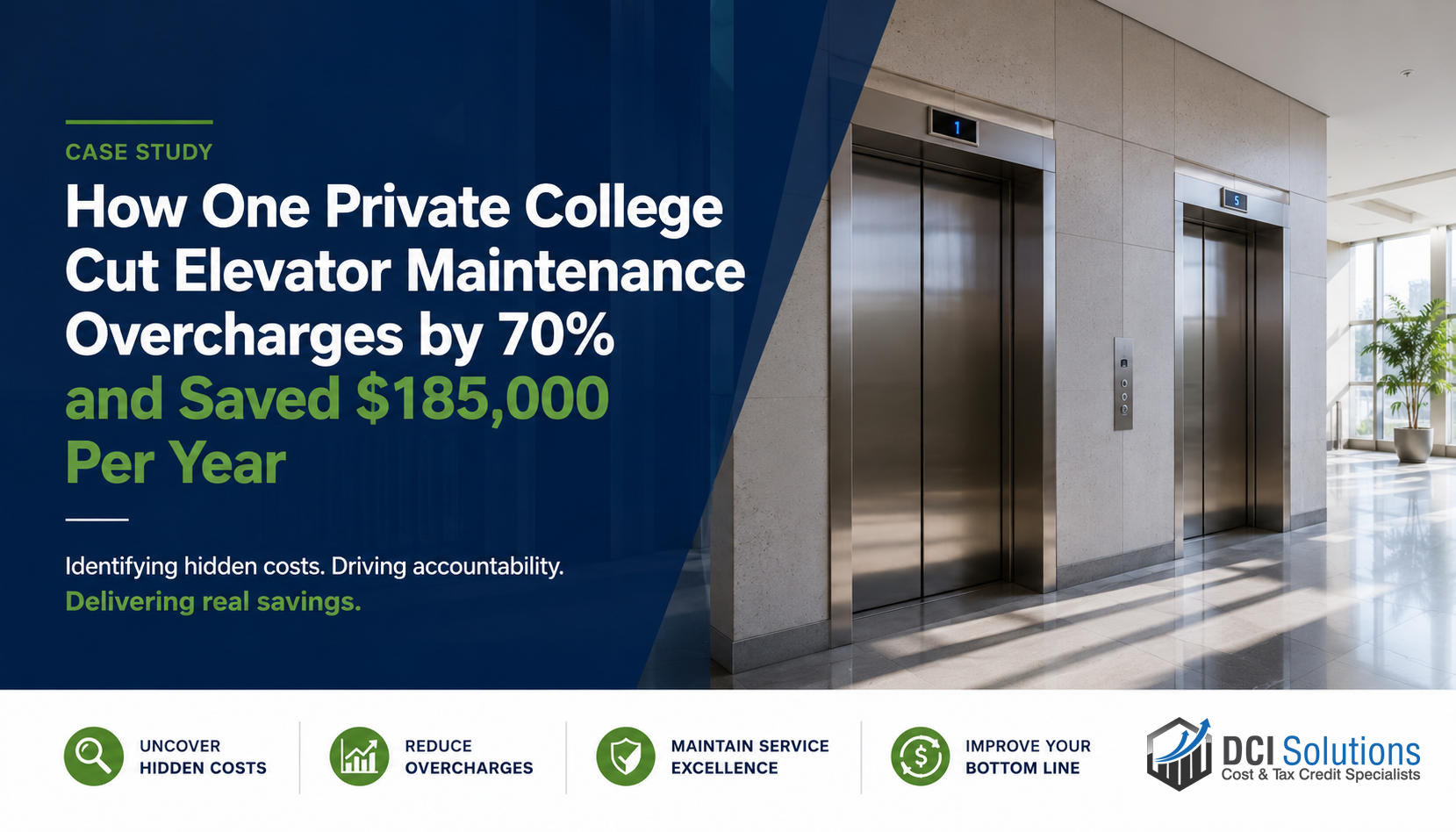
Elevator lobby with text about cutting maintenance overcharges by 70% and saving $185,000 per year.
By Kirk Conole May 18, 2026
Learn how a private college cut elevator maintenance costs by 70%, saving $185,000 annually. Contact DCI Solutions for effective strategies.
Infographic showing a restaurant’s 45% healthcare cost reduction, with before-and-after cost figures and a blue city backdrop
By Kirk Conole May 14, 2026
Learn how a restaurant group cut healthcare costs by 45% using self-funding & AI analytics. Contact us to explore similar savings!
By Kirk Conole May 8, 2026
Most companies accept annual freight increases as unavoidable. FedEx Freight’s LTL general rate increased 5.9% from 2023 to 2024, and then another 5.9% from 2024 to 2025. Over time, these annual General Rate Increases (GRIs) quietly compound into a major expense line that most businesses never fully challenge. But what if you could reverse the impact of those increases?
Hire students, unlock hidden tax credits; three smiling students in blue promo graphic.
By Kirk Conole May 7, 2026
Employers can unlock federal tax credits by hiring student employees. Contact DCI Solutions to maximize your savings today!
By Kirk Conole April 24, 2026
For many businesses, healthcare is one of the largest and fastest-growing expenses on the balance sheet. Yet the way most companies manage it hasn’t changed in decades. A recent case we worked on highlights just how costly that can be.
A professional team in business attire gathers around a laptop in an office, smiling as they collaborate on a project.
By Kirk Conole October 27, 2025
Employee engagement determines a company’s health and profitability. Across a wide number of companies, Gallup reports that the level of employee engagement follows a “1/6 : 2/6 : 3/6” ratio. 1 out of 6 employees (including management) resist the ownership’s goals and vision. 2 out of 6 support the ownership’s goals and vision. 3 out of 6 are “neutral.” They can be swayed by either the “resisters” or the “supporters.” Owners and executives should understand that they are competing every day with the “resisting “1 /6” to win over the neutral “3 / 6” and to sustain supportive engagement from the “2/6.” To improve the chances of winning this competition, leaders should recognize and avoid two common flaws: FLAW #1: CRITICAL LEADERSHIP “Critical Leadership” results in staff feeling less than fully appreciated if not rewarded for taking informed but unrequired risks that could be in the best interest of the company’s ownership. Example: The CFO and the controller of a privately held company understood how a specialized tax credit and cost review would recover substantial amounts of cash. “The problem,” he said behind closed doors, “is the owner of this company would criticize us for not being able to find this money all by ourselves without you. We can’t have that.” In this example, the company owners and all of the “stakeholders” lose valuable cash because an “Insufficiently Engaged Employee” didn’t want to accept what was misperceived as personal risk. FLAW #2: REMOTE LEADERSHIP The best leadership is close enough to offer clear guidance, incentives and accountability to ensure the organization’s health and profitability. When personal attention is too remote for too long a period of time, the important opportunities that should be first brought to the owner/CEO for an informed decision and then implemented by the staff are ignored or blocked. Instead, those opportunities are left for the staff to review and pursue or ignore according to their “personal perspective” and desire to avoid “personal risk.” This “Abdelegation” (combination of delegation mixed with abdication) is why too many great decisions and gains don’t get made in time, if ever. Example: For the last few years, an AP audit/recovery service recovered millions for a Fortune 1000 company. In response to a corporate directive to cut costs, the accounting department either had to let go of a well-liked staff member or discontinue the AP audit/recovery service, which was paying for itself many times over. The department discontinued the service. The company is now in worse financial condition than when the accounting department was asked to cut costs. Penny-wise and pound-foolish? Obviously, YES! But when given the opportunity to save jobs, many people will do so – even when it hurts the company and the common good. In both cases the decisions made by executives and staff were inline chiefly with the best interests of the company’s management personnel rather than the company or the company’s owner(s). The alternative is to replace the perspective of being overbearing and remote bosses to apply a leadership practice that causes employees to perceive them not as bosses, but as “Fully Engaged Employee-Centered Leaders.” To lead better, an owner/CEO should start with the assumption that the employer’s profitability is still secondary to other work-related priorities held by his VPs and department heads. Their priorities include: job security, career advancement, autonomy, peace, compensation (pay benefits, flex time), recognition (office relationships, peer respect, recognition from superiors), personal development, and the avoidance of more stress/work for which there is no extra reward. One simple improvement leaders can use to improve employee engagement and corporate profits simultaneously is DCI’s “3-A Communication.” The 3-A’s are: Align. Show how your decisions/goals align with employee well being and with the big picture. Affirm. Show respect and care for those touched by your decisions. Assign. Clarify roles, expectations and rewards for people carrying out your decisions. As an example, clients of DCI use this memo which incorporates “3-A Leadership” principles: Our executive team is committed to continually improving our employee well being with cost structure and financial health without reducing the quality of the services we give or the services we deliver to our consumers. To achieve these goals, we have engaged DCI Solutions to identify opportunities within our tax and overhead structure for additional discounts, credits, and refunds. Their mandate is to help us see worthwhile recoveries and cost savings without creating any risk for or unreasonable burdens on our staff. At some point DCI may request your time or input in order to expedite a savings for the good of our company. Your cooperation in this matter is necessary and appreciated. The resulting success reflects well on each department and person involved. The more effective DCI is in saving money for the company, the more profits we will have to grow our business and bonus our people. If you have any questions, concerns, or needs that cannot best be addressed by DCI Solutions directly, please feel free to contact us: info@dcisolutions.net | 760-809-8734
A healthcare professional uses a manual sphygmomanometer and stethoscope to measure a patient's blood pressure.
By Kirk Conole October 27, 2025
If you could see a ranking of business owners and executives who best control healthcare costs and then designate the “top 1%,” you would have to include Susan, the owner of a retail chain in the Midwest. Susan is a “one percenter” in controlling healthcare costs for three reasons: 1) She commits to thinking rationally about healthcare. 100% of rational, fact-driven business owners and executives tend not to view healthcare costs with the same rational approach they apply to other significant expenses. Unlike other expenses, health insurance directly affects employees who are seldom educated adequately on how win/win scenarios can benefit both employee and employer at the same time. Usually, the employee expects the employer to have the best answers but the employer is under-resourced and assumes that a commissioned salesperson, the health insurance broker, will be able to figure it out with input from the HR department. The HR department is motivated to have all employees happy and not complaining. HR is also motivated to show that costs are not escalating dramatically year over year. All brokers want to keep the client and most want to keep the current level of commission – a motivation that too often automatically separates the broker’s interests from the client’s. “Some owners see a broker the way tribal villagers see the village shaman,” Susan shared with me. “He’s the guy who interprets the dark secrets, and saves the employees who wholly trust him alone to deal with the things they don’t understand. This gives employees a sense of safety and security.” After gaining a full understanding of healthcare costs without the “help” of her previous retail broker, Susan had an interesting way of dealing with that broker. “I threw him off the porch,” she said. 2) She has owner/HR alignment. Both Susan and her HR department must: a) share an objective understanding of all healthcare cost drivers, and b) master the best alternatives for reducing costs. Their ability to be fully engaged and aligned, which is more than mere agreement, is the second factor that makes Susan a member of the one percent. We aren’t suggesting they must do all of this on their own. They can rely on the truly UNBIASED insight and ongoing support of DCI. 3) Her total cost puts her in the one percent. The total cost of healthcare is more than just the premium amounts. The true cost of healthcare is: TOTAL PREMIUMS FOR THE EMPLOYEE ONLY (EMPLOYER & EMPLOYEE SHARE) PLUS ALL ADDITIONAL PREMIUMS PAID BY EMPLOYEE OR EMPLOYER TO COVER DEPENDENTS PLUS ALL DEDUCTIBLES AND COPAYS PAID BY THE EMPLOYER AND THE EMPLOYEE. Add up those three component numbers then divide the sum by the total number of employees in your plan. What do you get? For companies in the bottom 50% of cost-efficiency, this number will be greater than $12,000 per employee per year (PEPY) . For companies in the top 50%, this number may be closer to $8,000 PEPY. One percenters like Susan are well under $5,000 PEPY. If you don’t already know your full cost on a PEPY basis, do the math yourself now or call DCI to perform the math with zero bias. It might be true that no one besides your retail broker could possibly reduce costs any lower and without sacrificing quality, but why risk it? Before your company commits to another year of unnecessarily high costs, contact DCI. Our solutions and strategies do not require you to switch brokers or networks and you don’t have to reduce coverage or increase employee deductibles. Our analyses give you the insight and power to be a one percenter! info@dcisolutions.net | 760-809-8734
A 15-minute candlestick chart of a financial asset showing a price decline, with moving average lines on a black screen.
By Kirk Conole July 24, 2025
When it comes to SEO, there isn't a magic formula to instantly send your site off to the #1 search result on Google. But there are some basic principles you should follow for a wonderful starting point. Here are the top 5 SEO practices to start with: #1 Write for people, not for search engines Always write original, interesting, high quality site content that's error free and relevant to your site. Search engines like Google can easily detect content that is duplicated from elsewhere online, that contains grammatical errors, or that is stuffed with keywords. #2 Add a blog to your site and use rich media To engage your site visitors and blog readers, create posts that include non-textual media like photos, videos, or original visualizations (infographics). Having that extra content (especially if it's captivating) will increase the time users spend on your site as well as the likelihood they will share your site with their own community. #3 Offer a positive user experience throughout your site Google will know if you're using your site to aggressively advertise your service, or if you're being too pushy. Always aim to offer site visitors a pleasant experience on your site. That means clear content, support when needed, and always an option to go back. #4 Create a network of internal links (but don't overdo it) Add links between different pages of your site and your blog, but try to follow a process that feels organic rather than heavy linking meant just for search engine crawlers. Link between pages that make sense, for example, on your services page, link a certain industry specific term, and link it to a blog post you wrote about it, that gives more information on that term. #5 Always check your site's Core Web Vitals Core Web Vitals are a standard site performance standard initially created by Google. The report shows site owners how their site pages perform 'for real,' how long it takes for site visitors to load site pages, and it offers ways to fix issues, if there are any.
A person in a business suit holding up a white sign with the text
By Kirk Conole July 16, 2025
Trying to grow into the middle market? Many business owners make the mistake of giving the “CFO” title to the overworked, under-equipped accounting manager. When a loyal, affordable accounting manager who lacks the ability to forecast future performance and resource requirements is made the CFO you might see these warning signs: WARNING SIGNS: Closings are consistently late and you don’t know why. Your bank covenants are never on time and you have a hard time getting funding. Your business valuation is below average for your market. Your repeatedly have unexpected cash shortages. You don’t really understand your financial statements. You don’t know what results to expect in the next 6-12 months. Employers with less than $10MM revenue who want to triple revenues should get high-level, strategic CFO guidance, even if part time. The right CFO talent will pay for the added salary cost many times over. The Fractional CFO The most cost-efficient way for many medium sized businesses to grow into the middle market is to deploy a top talent CFO on a part-time basis. How do you know when you’ve chosen the right fractional CFO? The first way you know is that the six warning signs disappear. The other way you know is when you say to your fractional CFO: “Ever since you came onboard, I know more about my business than I ever did!” WHEN TO CONSIDER A FULL-TIME CFO Business owners who want to further increase their cost efficiency use DCI’s Cost Efficiency dashboard. To learn how this increases profit and market value up to 10%, contact DCI Solutions at: info@dcisolutions.net | 760-809-8734
Two professionals discussing a complex flow chart and interface wireframes drawn in red marker on a large white board.
By Kirk Conole June 20, 2025
Optimize productivity and cash position and cash flow: When your business takes payment by credit card, the transaction fees that you pay might be as high as 4%. This means if your company has $10MM in card transactions, you pay $200,000-$400,000 in fees unless you offset those fees (which you can do all the way to zero in some cases). If your company takes payment by credit card from other companies, the interchange rate for B2B transactions automatically jumps even higher (an extra 1% sometimes) if you do not enter the additional data mandated by the card brands. That increase means if you have $10 MM in B2B card transactions, you could be paying up to $450,000 in total fees. Working remotely, you can get a lot of that money back. Sometimes all of it. Step 1 – You eliminate that B2B interchange penalty if you manually populate all the requested fields or, better yet, just authorize the integration of an automated workaround. Step 2 – You begin reducing your fees by sending a letter like the one below, including an independent analysis (see example below) and, if you like, a competing proposal. Dear Bank/Card Processor, We are evaluating our costs, including our costs for card processing as you can see in the attached fee analysis. We also have received this proposal you see attached for month-to-month service with competitive terms and no exit penalties. Could you please respond with a competitive bid and send it to me at your soonest? Our company would like to activate these savings quickly. Thank you We offer advisors a true win-win solution that really moves the needle for their clients and we build great relationships with any trusted advisor who would like to bring this kind of added value to their client base. To learn more, contact DCI at info@dcisolutions.net or (888) 395-0809