How One Private College Cut Elevator Maintenance Overcharges by 70% and Saved $185,000 Per Year
For many organizations, maintenance contracts quietly become one of the most overlooked areas of operational overspending.
That was exactly the case for one private college that engaged DCI to review its elevator maintenance expenses.
At first glance, the school already appeared to have a standard elevator maintenance agreement in place, paying a recurring monthly retainer of $13,294 per month to its elevator vendor. But beneath the surface, an additional layer of service charges was creating a major financial drain.
The Problem: Hidden Costs Beyond the Monthly Contract
During DCI’s review, we discovered the college had paid:
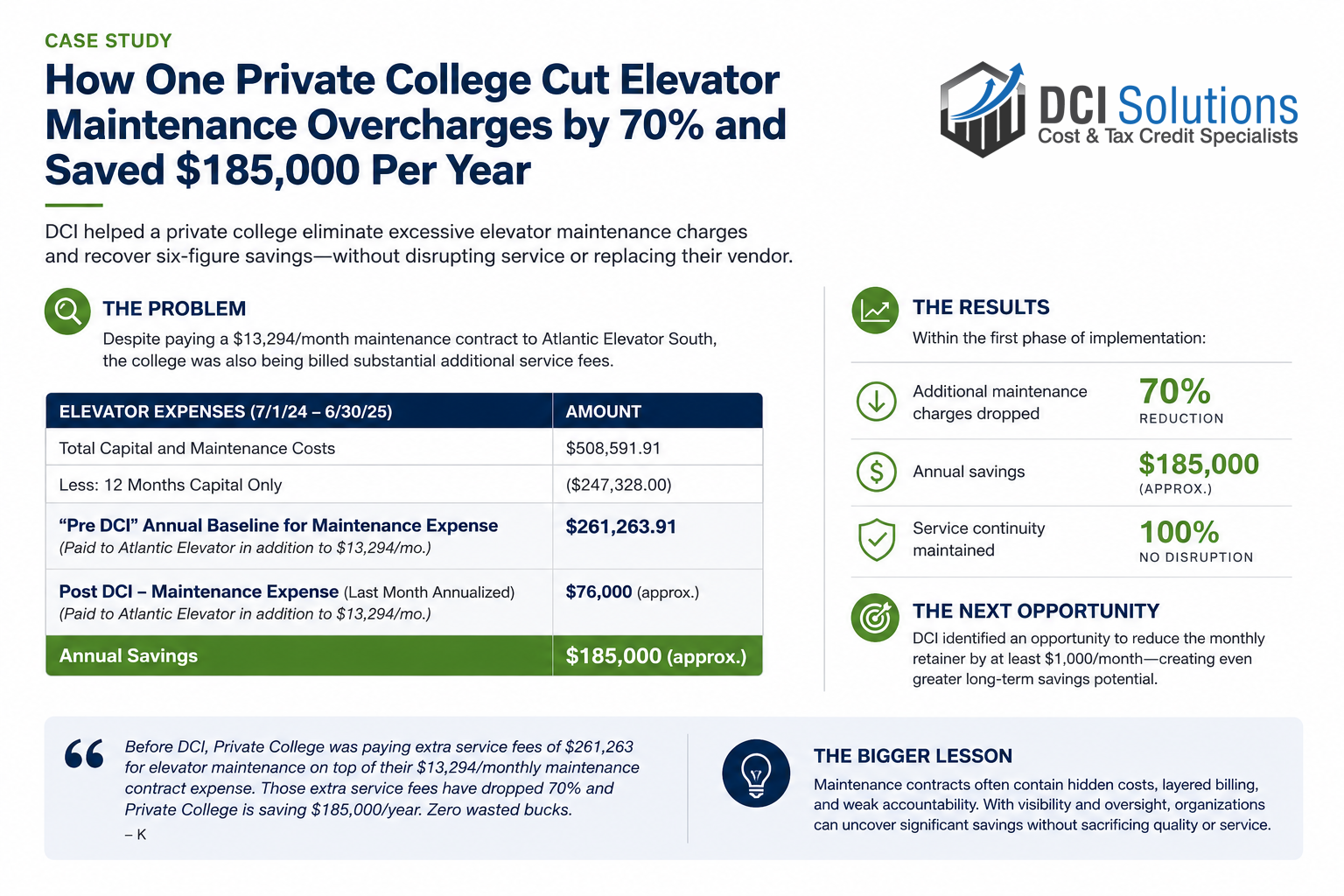
- $508,591.91 in total capital and maintenance-related elevator expenses over a 12-month period
- After excluding true capital expenditures, the school was still paying:
- $261,263.91 in additional maintenance service fees
- On top of the existing $13,294 monthly maintenance contract
In other words, the college was paying substantial “extra” maintenance charges despite already having a high recurring monthly service agreement in place.
This is a common issue in facility management contracts:
Organizations believe they are fully covered under a maintenance agreement, yet continue receiving large supplemental invoices for services that should often be controlled, negotiated, audited, or challenged.
DCI’s Analysis and Strategy
DCI conducted a detailed review of:
- Vendor billing patterns
- Maintenance service frequency
- Contract structure
- Charge classifications
- Additional repair and service call expenses
The analysis revealed opportunities to dramatically reduce excessive supplemental charges without disrupting elevator operations or sacrificing service quality.
Rather than replacing the vendor immediately, the focus was on:
- Tightening oversight
- Reducing unnecessary billable activity
- Increasing accountability
- Auditing invoice patterns
- Challenging avoidable overcharges
The Results
Within the first phase of implementation:
Additional maintenance charges dropped from:
- $261,263.91 annually
- To approximately $76,000 annualized
That represents:
- Roughly 70% reduction in excess service fees
- Approximately $185,000 in annual savings
And importantly:
- The college maintained elevator service continuity
- No operational disruptions occurred
- No reduction in safety standards or maintenance quality
The Next Opportunity
The review also identified another opportunity:
reducing the recurring monthly retainer itself.
DCI’s recommendation included pursuing at least:
- $1,000/month additional reduction
- Creating even greater long-term savings potential
The Bigger Lesson
Many organizations assume maintenance contracts are fixed costs that simply “are what they are.”
But in reality, these agreements often contain:
- Layered billing structures
- Unnecessary service charges
- Weak accountability mechanisms
- Invoice inconsistencies
- Legacy pricing that no longer reflects actual market value
Without ongoing auditing and operational analysis, those costs quietly compound year after year.
Final Takeaway
This private college’s elevator system didn’t need to be replaced.
Its vendor didn’t necessarily need to be replaced either.
What needed to change was visibility, oversight, and financial accountability.
That’s where DCI delivers value:
identifying hidden operational waste, reducing unnecessary overhead, and improving cash flow without disrupting day-to-day operations.
When organizations assume overhead expenses are “just the cost of doing business,” they often miss six-figure savings opportunities hiding in plain sight.
Let's Talk
At DCI Solutions, we help companies take a more strategic approach to savings.
If you’d like to learn more about how DCI can help your company, we’re happy to have a conversation.
Please feel free to contact us here: info@dcisolutions.net | 760-809-8734 or set up a meeting here .