Expanding in California? Get Tax Credits Now!

Kirk Conole • March 7, 2021

Your window to apply for these tax credits opens January 2, 2019 and closes January 23, 2019.


Does your company plan to hire more people or buy equipment in 2019?


Do you want to reduce the high tax burden you pay in California?


The Cal Competes tax credit is awarded to California companies that plan to expand in California.


Companies that win usually have these characteristics:


1)     They Pay Well 


The size of the credit is based on the size of the salaries you pay. Winning companies generally offer salaries more than $40,000 per year. The higher the average salaries are, the higher your tax credit will be if you win. Low salary employers can win, but only if they have other factors in their favor.


2)     Manufacturers and Technology 


Manufacturers and technology companies (especially tech manufacturers), who plan to expand, have an advantage over other companies. For example, if your company develops software, fabricates and/or assembles products, or produces food, you have an advantage that other companies don’t.


3)     Economically Distressed Area


If you’re located in an economically depressed area (ie: Stockton, Imperial Valley, San Bernardino, Central San Joaquin Valley), you have an advantage over companies in more robust economic areas. Companies in economically depressed areas often pay employees less than $40K/year, but given the alternatives, the state can still view these as “good salaries.” DCI won a large tax credit for a company paying low wages because the company was in an economically distressed area.


4)     Unique for California 


Your company’s uniqueness improves the probability of your success. If your company’s competitors are outside the state or outside the nation, then its unique status in California will increase the odds of your receiving an award.


5)     Don’t Ask for Too Much 


Companies that ask for too much tax credit don’t get a “counter-offer.” They simply get refused. You also don’t want to ask for too little and leave money on the table – a common mistake for companies that do win. If this sounds like “The Price is Right,” then you’ve got the right idea.


6)      Use a Pro 


Over 90% of Cal Competes applicants are rejected and many of those rejected could have been awarded tax credit if they used a firm with expertise and success in winning large amounts of Cal Competes credits. If you are assigning this important project to someone with little or no previous success in it, you could be robbing yourself of the expertise your company requires to gain the largest tax award. The paperwork is confusing and the multiple deadlines are so rushed that you are more likely to forfeit some or all of the money that a Cal Competes expert could produce.


Look for experts who don’t charge by the hour, since this will leave you financially out-of-pocket and upside down if you are in the majority of companies that receive no tax credit.


With DCI, there is no risk, or lost money and time, because fees are strictly based on successfully getting awarded the credit.


7)      Get the Timing Right


You cannot get the tax credit retroactively for expansion you’ve already paid for. You have to be awarded credit first and then all the hiring you do and the equipment and buildings you buy thereafter can count towards your credit if you win.


There are just a few windows in the year when you can apply. If you miss the January window you miss out on thousands of dollars in tax credit for every single employee you hire in January, February, etc. until the next window opens. Successfully gaining this credit requires timely, focused attention.


Don’t Miss the January Deadline! The window to apply opens January 2, 2019 and the window closes January 23, 2019. Contact DCI Solutions info@dcisolutions.net to discuss how this and many other specialized tax credits could add millions to your cash flow and long-term corporate value.



By Kirk Conole August 27, 2026
Every year, companies renew millions of dollars in Property & Casualty insurance with essentially the same process: The broker presents the renewal. Executives review it. Maybe there’s a discussion about rates or coverage changes. Then the company signs. Why? Often, it comes down to two assumptions: “Our broker does a good enough job.” Or: “It’s too messy to look into right now. We’ll just have to trust our broker.” But there’s an important question between trusting your broker and automatically renewing: How certain are you that your broker eliminated every meaningful coverage gap and left $0 on the table?  If the answer is anything less than “absolutely certain,” an independent review may be worth considering.
By Kirk Conole August 13, 2026
Many companies assume the only way to find out whether they're overpaying for Property & Casualty insurance is to shop the account. That usually means involving the broker, approaching carriers and potentially disrupting the market. But there is another option: independent, confidential verification. A company can evaluate its current insurance program to determine where it may be overpaying, where coverage gaps may exist and which appropriate markets may have been overlooked, without immediately alerting the incumbent broker or approaching carriers. That means no awkward broker conversation, no market disruption and no commitment to make a change.
By Kirk Conole August 5, 2026
When was the last time you called your own company to see what a prospective customer experiences? You might be surprised. While websites, chatbots, and AI assistants have transformed how businesses communicate, one fact hasn't changed: many buyers, especially executives and decision-makers over 60, still prefer to pick up the phone when they're ready to make a purchase. That's often the moment of highest buying intent. So what happens when they call? Too often, they're greeted by an outdated phone system that sounds like it hasn't changed since the 1990s: "Thank you for calling... For Customer Service, press 1... For Billing, press 2... For Technical Support, press 3... For Sales, press 5..." After navigating the menu, they're rewarded with another message: "The person you are trying to reach is unavailable. Please leave your name and number. Someone will return your call." At that point, many prospects don't leave a voicemail. They call your competitor instead.
By Kirk Conole July 29, 2026
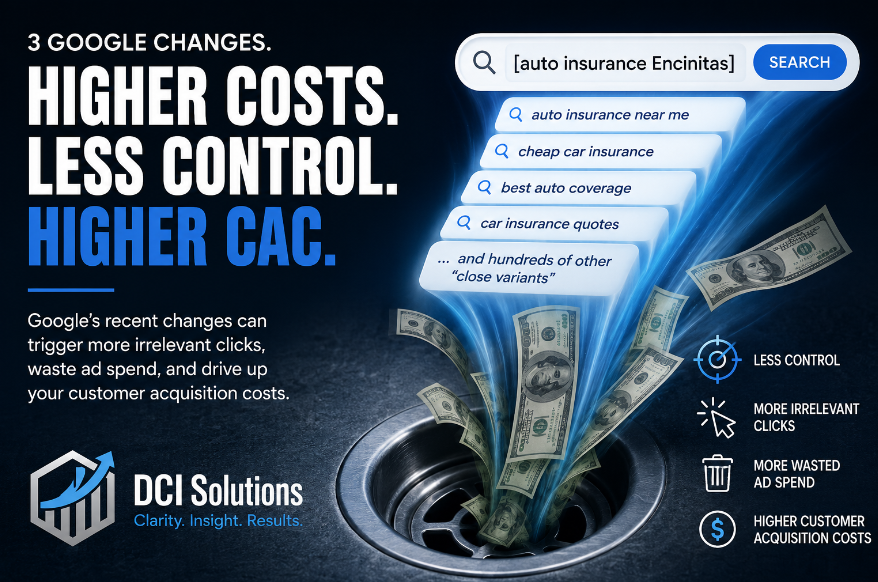
Google Ads has always evolved, but a few recent changes have made it more difficult for businesses to control where their advertising dollars go. Three changes, in particular, can have a direct impact on your customer acquisition costs (CAC): Expanded "exact match" keywords to include broader "close variants." Shifted more bidding decisions to AI-driven automation. Reduced transparency into how advertising prices are determined. At first glance, these updates may sound like improvements designed to increase reach and efficiency. In reality, they can also result in your ads appearing for searches you never intended to target. For example, you might bid on the exact-match keyword [auto insurance Encinitas] , expecting your ads to appear only for that specific search. Instead, Google may show your ad for broader searches it considers to be a "close variant." While some of those clicks may be valuable, others may come from users who are unlikely to become customers. The result is simple: More irrelevant clicks Higher advertising spend Lower campaign efficiency Increased customer acquisition costs Many businesses assume rising advertising costs are simply the new normal. In reality, a portion of that increase may be caused by how campaigns are configured and how Google's automated systems are making decisions on your behalf.  That doesn't necessarily mean you need to replace your marketing agency. It does mean it's worth taking a closer look at where your advertising dollars are going. At DCI Solutions , our independent advertising audit is designed to uncover wasted ad spend, identify hidden inefficiencies, and provide objective recommendations, all while allowing you to continue working with your current agency if you choose. Before increasing your advertising budget, make sure you're maximizing the one you already have.
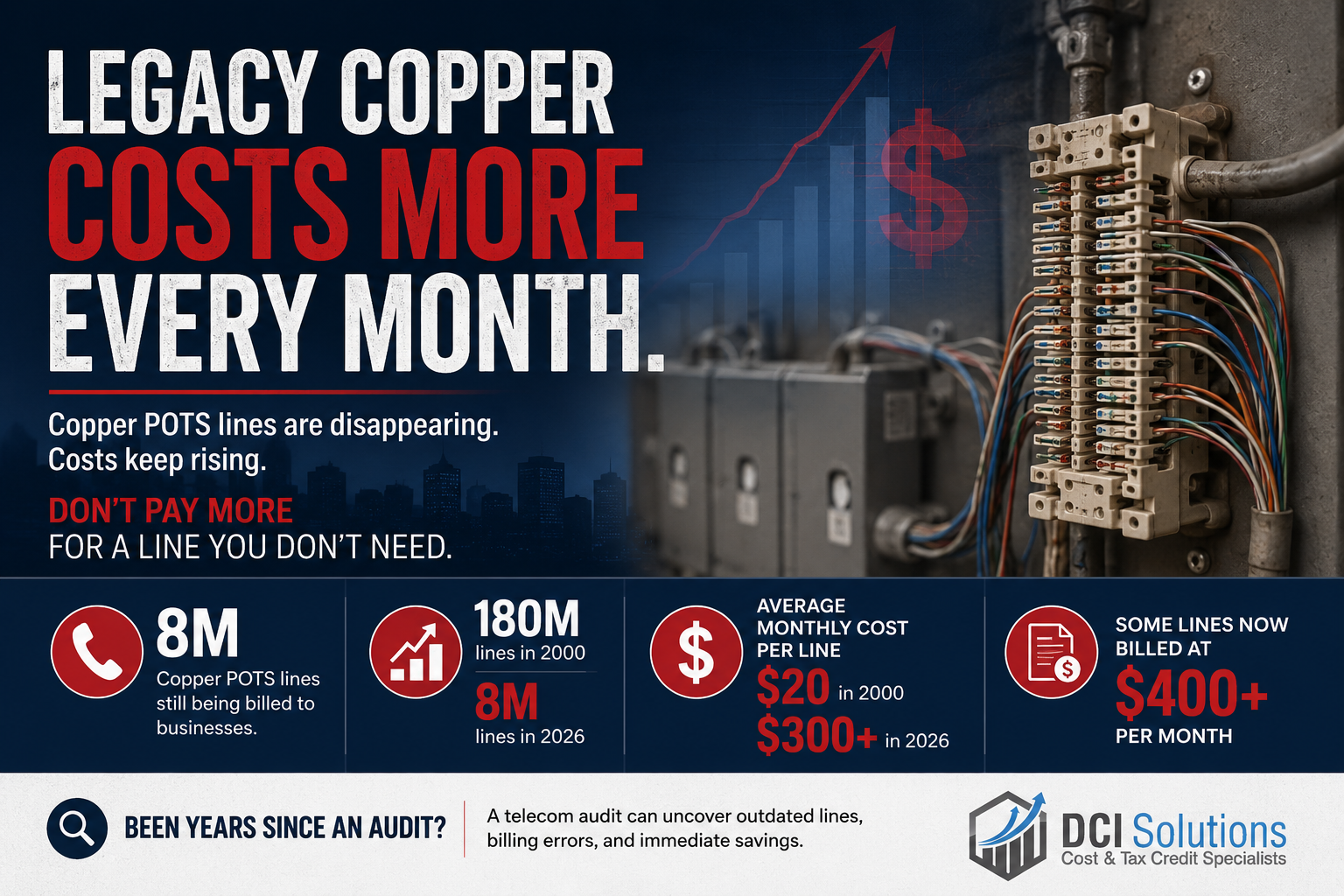
Blue ad: “Legacy copper costs more every month” with cable rack and cost icons from DCI Solutions.
By Kirk Conole July 8, 2026
Legacy copper POTS lines are driving up telecom costs. Conduct audits to identify savings. Contact us for help!
Construction promo graphic: “Structuring beats shopping,” claiming $1 million saved on insurance premiums.
By Kirk Conole June 23, 2026
Many construction firms assume the best way to lower insurance costs is to shop their coverage to as many carriers as possible. In reality, that approach often produces the same result: multiple quotes based on the same flawed assumptions, inflated values, and standard market pricing.  Recently, a builder reduced construction insurance premiums by more than $1 million without a traditional shopping exercise. The savings came from restructuring the program before it ever reached underwriting.
By Kirk Conole June 19, 2026
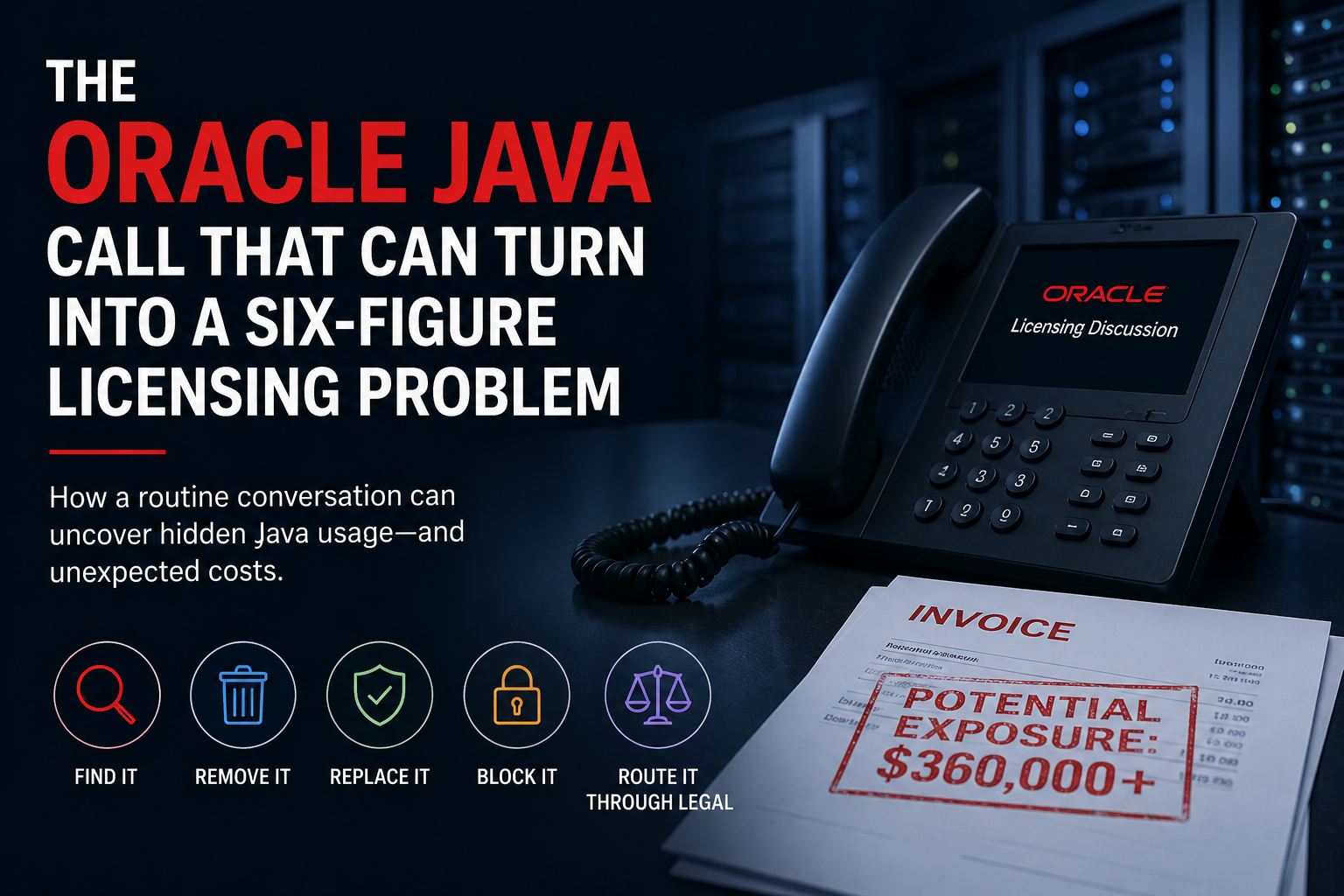
For many IT leaders, it starts with what sounds like a routine phone call. Oracle reaches out requesting a "quick discussion" about your Java environment. The conversation is typically positioned as a support check-in, a licensing update, a security discussion, or a general review of your organization's Java usage. On the surface, it appears harmless. In reality, the discussion often serves a much different purpose: determining whether Oracle Java exists anywhere within your environment. Once that is established, the conversation tends to shift quickly. Questions may include: How many employees does your organization have? Who is using Oracle Java? Which systems rely on it? Are contractors or subsidiaries involved? How broadly is Java deployed across the enterprise?  At that point, the licensing exposure calculation begins.
Blue Collar Workers tax credit flyer with earnings examples and white text on a dark banner
By Kirk Conole June 10, 2026
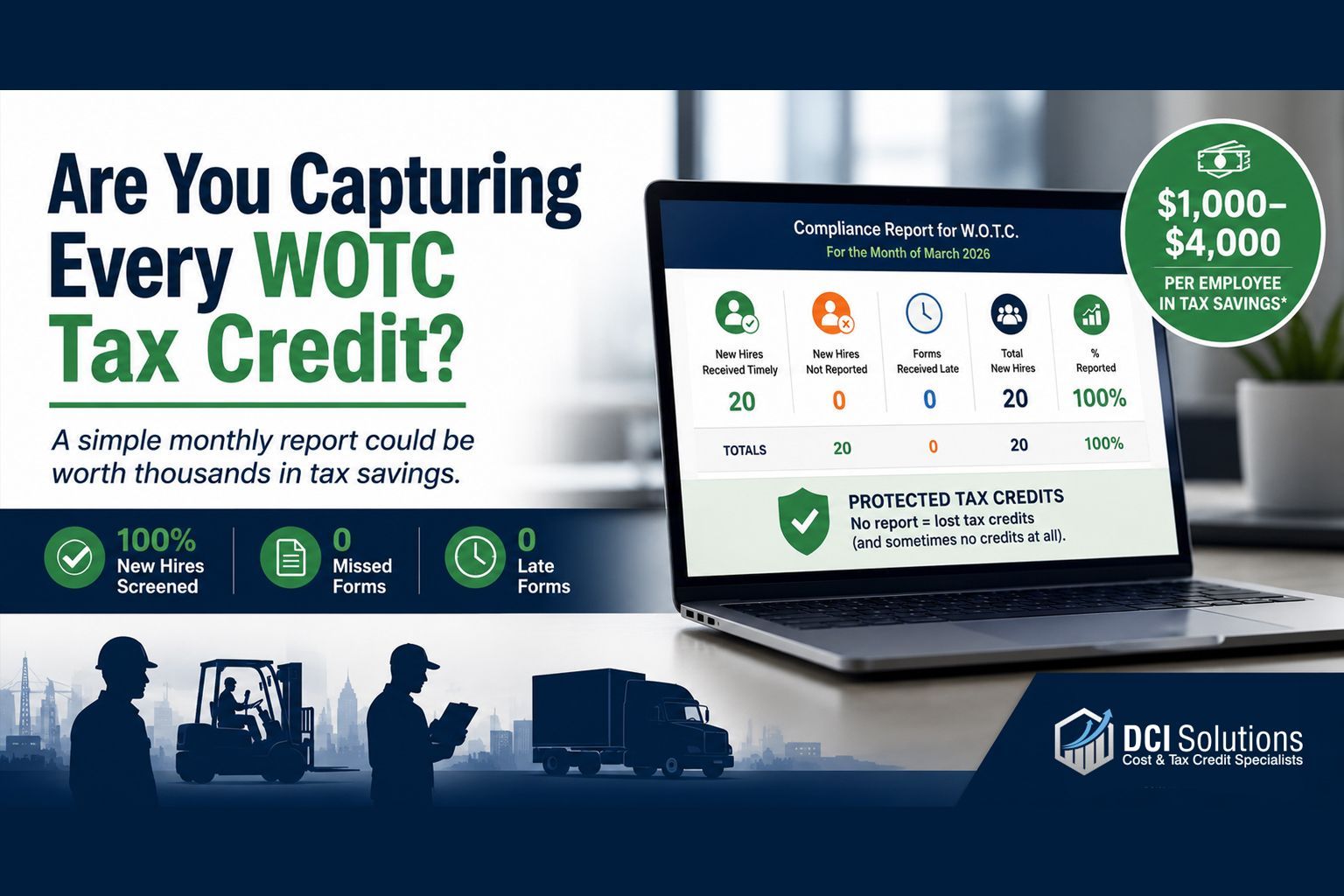
Many employers who hire blue-collar workers assume they're receiving every available Work Opportunity Tax Credit (WOTC). The reality is that many companies lose valuable tax credits simply because the process isn't being monitored correctly. One of the easiest ways to verify compliance is through a monthly reporting system. A simple report should clearly show: New hires screened on time Missed forms Late submissions Overall compliance percentage In the example below, the employer achieved: 100% of new hires screened on time 0 missed forms 0 late forms That level of compliance helps ensure tax credits are protected and available when it's time to file. The problem is that many organizations never receive this type of visibility. Without regular reporting, missed screenings and late paperwork can quietly eliminate tax credits that should have been captured. The financial impact can be significant. Even a relatively small number of qualified hires may generate thousands of dollars in tax savings. In many cases, companies discover additional opportunities through an independent audit of their tax credit and operational processes. A thorough forensic review often uncovers overlooked savings, compliance gaps, and process inefficiencies. For many organizations, the combined effect can translate into meaningful cash flow improvements without changing vendors, disrupting operations, or taking on additional risk. The question isn't whether WOTC credits exist for your workforce. The question is whether you're capturing every dollar you're entitled to. When was the last time an outside expert reviewed your process?  Being busy is understandable. Leaving money on the table isn't.
By Kirk Conole June 4, 2026
For decades, employers have been conditioned to believe that health insurance claims reports are the key to understanding healthcare costs. They're not. In fact, by the time most employers receive a claims report, the information is already historical. It tells you what happened, not what's likely to happen next.  That's a problem when healthcare spending continues to rise and employers are being asked to make critical decisions about funding strategies, stop-loss coverage, network selection, and employee benefits.
Man walking on a road at sunset with bold text about hard work, discipline, and performance standards.
By Kirk Conole May 27, 2026
Learn how high performance standards reveal hidden savings in your business. Contact DCI Solutions for expert cost management today!